
“I immediately knew something happened…I looked down and my fingers were gone.”
–Cody Simmons

It’s quite likely the most terrifying thing a woodworker’s spouse ever hears: I’ve had a bad accident. That’s what Cody Simmons had to say to his wife, Shiloh, when he suffered an accident on the table saw in his garage workshop.
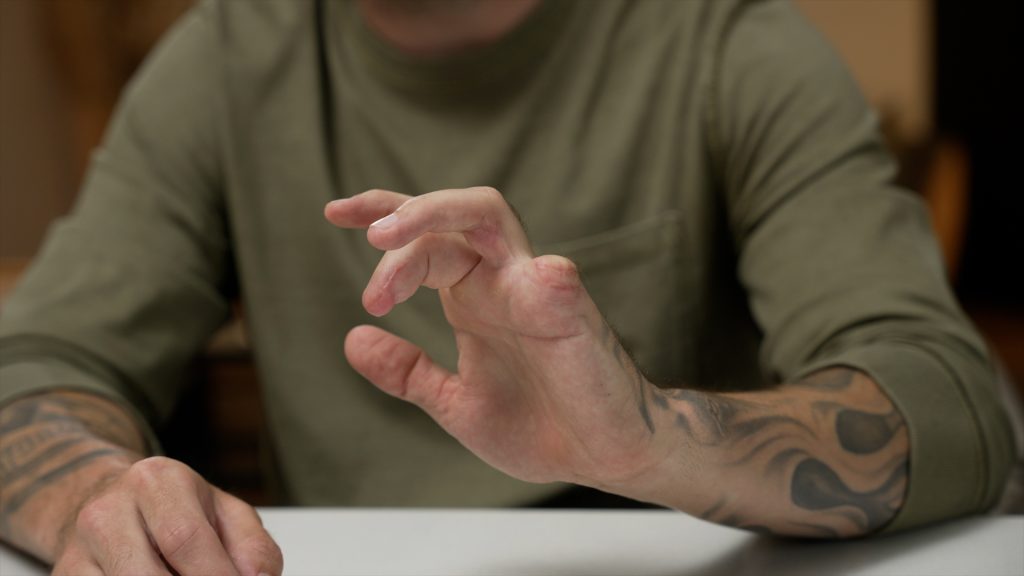
“I told her to call 911, went back into the garage, and that’s when I started looking for my fingers to see if, maybe, they could put them back on,” Cody recalls. Just a minute or two earlier, he had been making a jig on his table saw when the workpiece bound up and kicked back, dragging his left hand into the blade. The blade severed his pinky finger, badly mangled the ring finger, and severed the top section of his middle finger.
“I told her to call 911, went back into the garage, and that’s when I started looking for my fingers to see if, maybe, they could put them back on.”
–Cody Simmons
“My son was in bed,” said Shiloh, “and me and my daughter were doing an art project, and I remember hearing the saw going, and I remember hearing something get stuck in it. And, all of a sudden, he opens the garage door, and he’s, like, ‘Babe, call 911.’ I already knew what happened. I already knew something happened with the saw. So, before even going out there, I called 911. Then I went out there, and it was like a murder scene. There was blood all over…”
Police arrived five minutes after the call, followed closely by an ambulance. They stabilized Cody and stopped the bleeding, then took him to the nearest hospital. Cody’s father lives nearby, so he came to stay with the kids so Shiloh could go with Cody.
“They took me straight back (in the emergency room),” Cody said. “From there, it was just kind of getting me stable and on pain meds. And then they started to ask what we wanted to do with the fingers. Originally, they said that there was no way for the pinky to be reattached just because of, with a table saw, it rips your skin quite a bit, and it’s tough to kind of attach that back together.
“They (doctors) said it was a 50-50 chance that (reattachment) would work. And so, with it being 50-50, I was like, you know what, let’s just not even go down that road because if it doesn’t work, then we’re back in here having surgery again or something. Plus, if (the pinky) doesn’t (fully) work, it’s more dangerous. If I start woodworking again, it’s just sitting there. So, I just made the call to not even worry about doing that.”
He was scheduled for surgery the next morning, but another life-altering event nearly prevented that from happening.
“They were giving him a cocktail of different prescriptions, so much so that his heart wasn’t used to it,” Shiloh recalls. “So, the pain medication they gave him right before he went into surgery, I guess, you’re not supposed to mix within a four-hour timeframe, and he actually ended up going to surgery a little earlier than was scheduled, so his pain medication mixed with the drugs they gave him to put him under made his heart stop. And, so, he actually (died) in the hospital.
“They gave him a drug to reverse the overdose. So, I’m up in the hospital room waiting. They told me what happened. They’re trying to get him to breathe on his own. And so, finally, after about an hour of waiting, they brought him up. He was stable and everything was fine after that.”
Cody stayed in the hospital for several days before going home to face his new reality.
“When he got home from the hospital, he wasn’t able to do anything for, I’d say, about a solid month,” Shiloh said. “He wasn’t able to change a diaper, cook for himself, do anything as far as involving the kids, or even, I guess, getting dressed. I had to help him with that.
“The first two months, I could tell he was kind of down, coming to terms with, ‘Oh wow, I don’t have those fingers anymore.’ Seeing him trying to cut food the first month and a half, I could see he was struggling. He was trying to figure it out. I was having a very hard time with it. I didn’t want to let those fingers go. It did take a few months to adjust to it, but now it’s our new normal, but it is sad.”
“So I started doing occupational therapy,” Cody said. “I went twice, I think. But since then, I’ve just kind of been doing it on my own. They gave me a bunch of things to do here, just kind of while I’m sitting around. Like some nerve stimulation stuff, which is like a little shocking thing, so it desensitizes the nerves. Because at first, they’re really sensitive and any kind of like tap or anything like that is really painful. So, a lot of desensitizing, a lot of trying to get full range of motion.
“There are still times where we could just be doing some normal activity and look down and we’re like, wow, I can’t believe it’s real.”
“Just naturally, I’m a pretty optimistic and positive person, but obviously, this accident, it’s a life-changer.”–Cody Simmons
Cody’s woodworking business, where he specialized in making tables and benches, also took a near-immediate hit.
“We had really just started,” he said. “We had to completely cancel all orders. We had somebody helping us at that time, and we had to let him go. We had to refund everyone back who had ordered from us. And really, on that front, was the financial change for us.”
In time, Cody also had to give up one of his passions: Motocross. He had raced motorcycles as a kid, then became a mechanic, still riding for fun.
“Really, my concern was just gripping the handlebars with all the jumps and things like that. And then you also have to use the clutch (with the left hand). Really, just the concern of, could I hold on good enough, and I don’t want to go down the road of getting injured because of that. So, we just decided to sell the motorcycle and not risk it.”
Fortunately, Cody received overwhelming support from his full-time job, where he works as a mobile game developer. He missed a few weeks, then returned to work. The health insurance also helped to cover most of his medical bills, preventing a financial disaster.

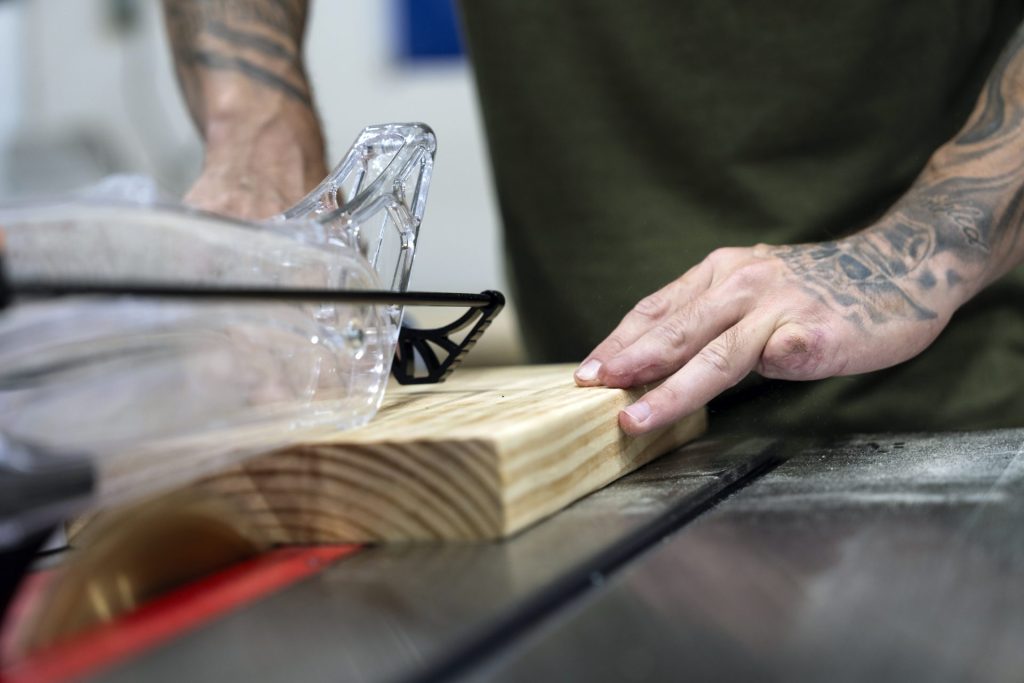
Cody slowly returned to the wood shop. His first action: Replacing his old table saw with a SawStop cabinet saw. And even though he now makes things only for his home and family and the hobby of woodworking, he says it’s still enjoyable.
“I don’t know that I want to get back into the small business side of things, but I do want to make furniture that we enjoy and we keep here and kind of just our heirloom pieces for our family. I really just enjoy the creative side of designing the furniture and then making that come to reality. And the SawStop, it just makes it so much safer.”
Replacing that saw also eased Shiloh’s worries.
“I didn’t want him to get back into that world again, definitely not use a table saw again,” she said. “I’m more comfortable with him using (the SawStop), knowing how much safer it is for everyone. I’m not as anxious having him out there alone, knowing he might just get a little nick on his finger versus sawing off a limb or something.”
“(Your) husband could go out in the garage, and you’re making dinner, and then his fingers are cut off. And I just think everybody doesn’t realize it can happen. It can happen to you in a split second.”
–Shiloh Simmons
And so, Cody, a four-year Army veteran, goes back to being a hobby woodworker as he and Shiloh and their two children adapt to life with a compromised left hand.
“Just naturally, I’m a pretty optimistic and positive person,” he said, “but, obviously, with the accident, it’s a life changer. I see it as a challenge to get back to the things I used to be able to do. But when I think about my young son only knowing me without all of my fingers, it’s a little bit more emotional, not so much of a personal challenge. That kind of hits you more, I guess.”
